Monday, 4 May 2015

Question 3: What have you learned from your audience feedback?

Viewing in full screen will allow for easier reading.
Alternatively, you can find a download to the source document here

Sunday, 3 May 2015

Question 4: How did you use new media technologies in the construction and research, planning and evaluation stages?


Q4 Evaluation by Slidely Slideshow

Above is a slidely comprising of the majority of the websites, applications and resources I used throughout the year. Below, I have organised them into individual sections and discussed how each has aided me with each section of the coursework.

Browsing and Research
This group is comprised of Safari, Mozilla Firefox, Google Chrome and Survey Monkey
This group was essential in the research and initial concept phase of the production. I used these to gather images, facts, research as well as access the web for downloads and posting my work on my blog. Survey Monkey was used as an online collection data collection, and I used it to collect data for the initial planning of the game as well as collecting audience feedback, after the main production and ancillary tasks had been created.
Creation


Mission Maker was the program I used to create my main task. It is a level creation software package created by Magical Projects.
Using Mission Maker was ideal as I had never created a 3D game before and it providing all of the tools necessary to quickly create a working level with similar features to that of a real game created by a development team. However, if I was to do the project again, I would not use Mission Maker, as the program itself is very buggy and unintuitive at points, which significantly slowed down production and overall lowered the quality of the game substantially.


Video and Editing
The following group is comprised of Sony Vegas, iMovie and Open Broadcaster Software. I used these in order to record and edit various small clips as well as create a playthrough of the production. I used iMovie on the iMacs in school and Sony Vegas whilst at home to edit clips. OBS was used in both as the recording application. Aside from iMovie, i had never used these applications before, and I found Sony Vegas particularly challenging to use, as it is used in Industry as a professional video editing tool. OBS was fairly simple to use, with very little having to be done to be able to record my screen. If I was to do the task again, I may choose to use only iMovie for editing.

The last, and largest group comprises of the applications and websites I used to present my work and various tasks. Photoshop, Microsoft Word and PowerPoint were used to create and present the ancillary tasks, the Box Art and Magazine piece. YouTube and Slideshare were used to host the videos and presentations I created respectively, and were then linked onto my blog, which was hosted on blogger itself.
Prezi was used to create the interactive, web based presentations and BeFunky to create the various collages used throughout the course.

These applications allowed me to summarise and condense the work I had done and submit it all into one place, on my blog, to be presented. I have learned to use a variety of techniques, such as the quite advanced photo editing techniques within Microsoft Word as well as the creation of videos including commentary. If I were to do the task again, I would likely use the same set of technologies again. 

Friday, 1 May 2015

Question 2: How effective is the combination of your main product and ancillary texts?

For this task, I have created a Prezi which you can view below:


Question 1: In what ways does your media product use, develop or challenge forms and conventions of real media products?

For this task, I created two 9 shot grids, one comprising of images from my game, and another comprising of images from other games to compare with mine. You can see both below.
The numbering goes from left to right on both grids.


Each image represents a different feature from the game, for example, the first image on the top left hand side shows the enemy of our game. It is a basic alien which appears several times throughout our game. On the second 9 shot grid, you can see it's counterpart from the game "Alien:Isolation". This shows the main enemy of that game, the "alien". Below I will compare and contrast the elements of my game to those in real life media products (games).


As discussed above, this picture shows the common alien in the game. They are the basic enemy that the player will face. I chose to use an alien for the main enemy faction in the game as it is a common idea in Science Fiction, the genre itself, not just games, that the humans are the "good guys" and the aliens are the "evil, invading menace". This shows my game conforming to the generic conventions of Science Fiction games. 


As an example of these conventions, I have used a picture of the Alien from "Alien: Isolation". This game pits humans, which are typically the players, against the alien/s, depending on the mode, which is typically AI. 


This picture is representing the "action" aspect of the game, showing a typical combat scene in the game. When compared to real media products, my game both conforms and differs from the traditional stereotypes. It has the basic "First Person" premise, where the player can see what their character would see, but my game limits the player to only one weapon and ammo type. In most Science Fiction and First Person Shooter games, the player is able to use a variety of weapons to dispose of enemies. I have chosen to only allow the player to use one weapon to provide a contrast between my game and the traditional game.


This image shows a combat scene from a very popular Science Fiction arena shooter "Unreal Tournament". In this game, the player engages in fast paced combat with other players/AI. This is alos a game where the player is able to use a range of weaponry, depending on their preference and what is the suitable for the engagement. As you can see, the basic HUD (Heads Up Display) features are similar to those in my game, with health, and time count being displayed at all times.


This image shows off my games version of a boss. Bosses are commonplace in most games, as they provide an additional challenge to the game in order to finish a level. This shows conformity to real media products. Special effects are also typically added to boss mobs, such as increased size, health, damage or even the fire effect which you can see on the image and the one below.

This image shows a boss mob from the game "Fallout 3". This boss features qualities discussed above, having more health and being significantly larger than average enemies, with the player having to use different and more innovative methods to kill it. You can see the similarities between my boss and this one.


A common feature in real games, is a companion or buddy system. I have used this convention in my own game, with this little robot which can be found hidden in the game. Once found he will accompany the player throughout their quest. Due to the limitations of Mission Maker, I was unable to do much more, but in a typical media product, the companion would have special abilities of their own which would aid the player throughout the game.
The image to the left shows an example of a companion from the game "Mass Effect 3". In this game, the player is able to recruit a number of companions to aid them on their journey, each with different abilities. This shows the convention within real media products.


This image shows my "special" character that appears in my game at several points. This is a development on the convention established by the game "Half Life" in which a mysterious character seems to aid the player at several points, with little reason why. In my game, G1BS0N appears when the player completes the side quest, and will aid the player with their quest. He will also converse with the player and would have played a larger role in the main game if I could continue with it.


This is a picture of  "G-Man" who is the special character in the "Half Life" series. I drew inspiration from him in the creation of G1BS0N.
 Another feature is the background visuals of the game. As in many Science Fiction games, the use of space or the stars is a common convention. I have used this convention myself, with the tileset you see on the left.
This is an example from "The Elder Scrolls: Skyrim" as my proof of this convention.  


Quite a big concept in Role Playing Games (RPG's) is the use of treasure or "loot" as a reward for completing certain tasks. This loot then gives the player better firepower, abilities, supplies or access to other areas. I have incorporated this convention in my own game, with a reward granted to the player once they complete the side quest.

This is an example of the RPG "reward" system in a game called "Borderlands 2". In this, completing various tasks awards the players with higher tier weapons which makes the game easier or allows for the completion of more difficult tasks.
 The concept of "Quest-Givers" is also common in RPG's. Certain non playable character "NPC's" will give the player quests with rewards for completion. Usually the storyline will follow upon this method, as it is a way for the game to ensure the player follows the correct path. I have incorporated that idea into my game, but I have developed upon the idea by not marking the quest givers. This makes the game feel more fluid and natural.
 This is an example of the Quest Giver system being used in a real media product. This is from a game called "World of Warcraft", and the player is tasked to find these quest givers and complete the quest in order to progress through the game.


The final concept I am going to cover is the map system. This is a concept used in most games, however in mine, I have developed the idea further. In order for the player to access a map of the game, they must pick up a certain device, which will then display a map in the areas which they have visited. This differs from the average game as most games allow the map to be viewed at anytime by simply pausing the game.
An example of this below, from the game "Call of Duty: Modern Warfare 3" where the player can access the map to see where they are, and where they need to go at any point.


Sunday, 26 April 2015

Finished Game: Playthrough

Below is a video of a playthrough of our level that we have designed. This is so you can see what the level looks like when completed in it's entirety. A link will also be below where you can access the raw file, if you cannot view the video on this page.


Link here

Friday, 27 March 2015

Magazine Covers


For this task, I had to create a magazine article to advertise my game. My planning and final version are below:


Click on the image to enlarge
This is my sketch of the front cover of my magazine. I will be using PCGamer as a base. The background will be a screenshot from within the game. In the top right will be the moon, and in the centre will be a medium shot of G1BS0N.
On the left hand side, it will advertise an exclusive interview with the developer, which I will conduct on the double page spread.
I have also included other news stories, as most of the covers I looked at in my research, featured more than one specific story on the main page.
On the right, I have a few unspecified quotes, making it obvious that the game is a Science Fiction game, as well as comparing it to Fallout 3. This will hopefully attract people who play Sci-Fi games and/or Fallout 3 and haven't yet heard of the game. It will also grab the attention of those who are fans of PC Gamer, and value the opinion of the magazine highly.
In the top right hand corner is advertising for an SSD. This will serve as the "free gift" incentive that PC Gamer seems to include in each edition of their magazine.
Click on the image to enlarge
This is my sketch of the double page spread. It is done on a landscape A4 page, so it isn't to the same scale as the spread will actually be.
There will be 3 main columns to the spread, the left hand side will be a short description from the magazine itself, which will act as if they had a small demo of the game, and give their thoughts. The middle section will be screenshots from the game, one of an action scene, one of a close - up with G1BS0N and the last one being the box art from the previous ancillary task. The far right column, will be the interview with the lead developer. This interview will talk about how the game is structured around its intended audience, and specific beginner features have been included, such as the terminal at the beginning of the level.

Click on the image to enlarge
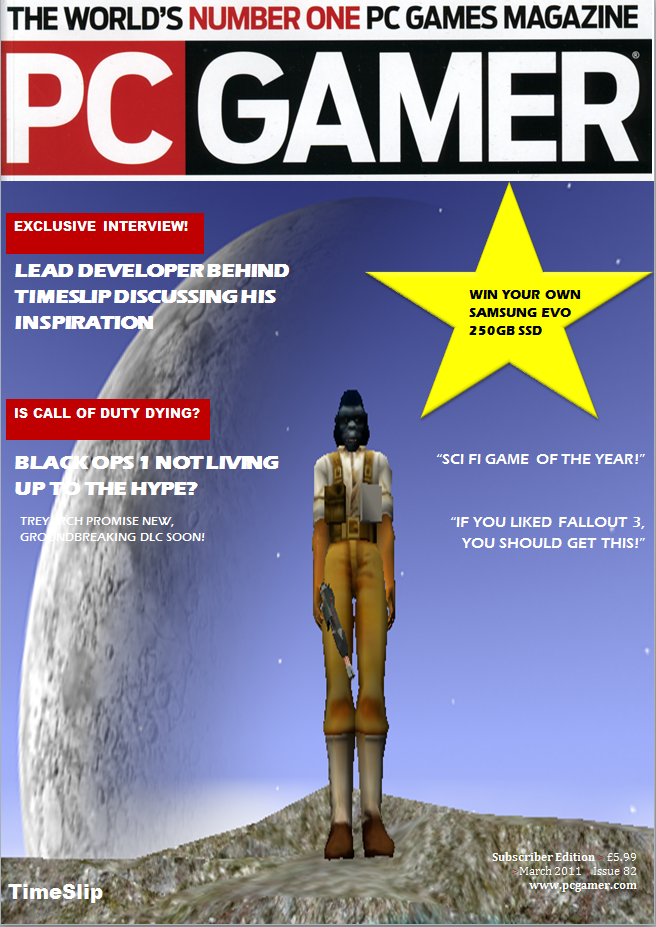
This is the finished version 1.0 of my front cover to my magazine. There were quite a lot of changes from the original plan. I found an image for the original PC Gamer banner, which does change quite a lot. The circle on the right, which contained the advertisement for the free SSD, has been replaced by a gold star. This is because I think it is more fitting to use a star here. The quotes have been slightly changed. It now explicitly compares TimeSlip to Fallout 3, to clear up any confusion.
The boxes containing "Exclusive Interview" and "Is Call of Duty Dying" have been changed to red, to fit in with the PC Gamer theme. The background image was not actually sourced from the game, as there was no part of the level which was open enough to get a full shot of the moon like I wanted. To get around this, I made a small level using a similar tileset, then moved a replica of G1BS0N into the level and took a picture that way.


Click on the image to enlarge


After conducting the a round of audience feedback, it was noted frequently that the cover of the magazine was not as effective at it's task as the rest of the products created for ancillary task 1 and 2. A few of the criticisms included "The star doesn't quite fit in with the rest of the page" and "The title is lost in the corner".
As such, I have made appropriate adjustments as you can see above. I have replaced the star with an actual image of the device that the audience could win, and changed the font and colour text slightly so that it stands out a little more from the rest of the page. I have also moved the title from the bottom left hand corner, to the top right and have massively increased the font size to make it more obvious, as well as colouring it in the typical Science Fiction colours. It should be noted however, that this goes against the typical PCGamer house style, as in the majority of the covers I looked at, the game's title was in the bottom left of the screen, as it was the image from the game that was used as the selling point of the cover, not the actual game itself.
Another adjustment made, is the addition of the circle in place of the title in the bottom left hand side. This now contains relevant PC articles which would be included later on in the issue if this was a real magazine. They are coloured bilaterally as to fit in with the house style as well as break up the colour so that it is more easily readable. The last major change was addition of small circles containing other popular games, The Elder Scrolls: Skyrim and Crysis 3, that were realised that year. These help break up the front cover and provide attention to other games, which a real life front cover would do. Another text box was added, providing an explanation of "Trailer Analysis" to the images.

Click on the image to enlarge


This is the finished version of my double page spread. Essentially it is the same as the sketch plan I did. A few additions were the rating on the bottom and the text box in the centre. These were implemented to break up the page a little, and provide a little variation. 
The text on the left hand side reads as follows:

"When I first heard that BlitzHammer studios, a relatively small Indie developer was planning to make a “noob friendly” AAA equivalent game, I was sceptical at best. But after the promotional material we have seen and the small first level, in house Alpha, we were lucky enough to play, I have got to say, I am blown away by the amount of potential I think this game has. The level looks amazing, lacking in graphical sense, I must admit, but the layout and design is superb. Playing through it, I could tell that on the difficulty it was on, a new player would have no trouble navigating through the level as easy as they do their own house. On top of that, the enemies AI seems to scale with the difficulty level, so at the easier ones it’s like shooting fish in a barrel, which is what a new player needs on the first level. Whilst at the harder difficulties, I almost felt that the enemies I was facing were real, competitive players. There is still a lot we have got to look forward to, and the Lead Developer has been teasing a new trailer for some time, and I can say with full honesty that I am exceptionally looking forward to that. I can’t wait to see the story of the game unfold, and see some of these other characters. We were teased with G1BS0N in the Alpha, who serves as a unusual “G-Man” type character throughout the game, helping or hindering the player depending on the choices they did OR didn’t make. For an independent company, this is stellar game making, and im not excited to see if they will win any awards at E3, but how many they win."


The text on the right hand side reads as follows: 

"What game would say was the main inspiration behind the creation of TimeSlip?

Personally, I would have to say Fallout 3 by Bethesda Game Studios. I must have several hundred hours on that game across multiple characters and play-throughs. As soon as the executive producer came to me and said “I want you to create us a Science Fiction game” Fallout 3 was the game that immediately sprang to mind. Of course TimeSlip does have it differences; it’s more aimed at a younger, beginner audience than the hardcore players. Being a brand new IP, we thought it would be best to focus more on the “noob” demographic, and provide a game tailored around them.


You say TimeSlip is aimed at the beginner demographic, how have you tailored the experience to meet their needs?

That’s a good question and brings up something I mentioned at the last conference. TimeSlip is a very beginner friendly game, offering a very in depth and “tutorialised” first level.  On the easier difficulties, the game doesn't punish players who don’t have perfect accuracy, it doesn't penalise those players who might not understand the basic principles of a First Person Shooter, such things like reaction time, movement, perception. The game is much more focused on introducing the player to these principles slowly, and at their own pace.


What about players who are “veterans” of FPS’s and RPG’s? Why should they purchase TimeSlip?

Well basically, it’s a new IP. We can go anywhere, do anything we want with it. TimeSlip is extremely story driven, with a very interesting plotline, which in my honest opinion, would make for a cracking film. The harder difficulties are more scaled for the vets of games, precision and reaction times are essential and the game punishes you hard. The RPG element plays more of a role too, you have to watch your ammo count, mediate your med-packs and those surprises hidden in the corners.
Any Multiplayer or Co-Op planned in the future?

Not currently, but you never know, we have a lot of things yet to announce.


Thursday, 26 March 2015

Research for Ancillary Task 2


For this task, I had to conduct research on Front Cover's and Double Page Spread's in magazines, in order to see the differences as well as the art styles used. I also had to analyse how they represent the games they are covering and advertise them to a specific audience. I also had to cover how the magazine itself used the games in order to see copies, this was particularly prominent on the front cover analysis I did. 


To start with, I purchased a copy of PCGamer. This is because PCGamer is the most well known gaming magazine covering PC Games, and as my production is a PC Game, it makes the most sense that it would be featured in this magazine, should it be real.
 This is the front cover of the issue I bought. The issue number was #277 and covered April 2015. The main focus on the front is "Fable Legends" and their "Exclusive Access" to this game. Immediately this catches the attention of the audience, as anyone interested or knowledgeable about the Fable series, will be interested in this issue. I could use a similar approach in my cover, except my game is a brand new IP (Intellectual Property), so it will have little to no prior fan base. In order to use a similar style, I would have to make it more apparent what genre and style of game it is. This front cover doesn't need to, as Fable is a very popular RPG made by Microsoft, and was exclusive for their consoles. There are some hints on the genre and type of game by the clothing the man is wearing, but nothing definite, like I will have to do with my cover.

There is also a great deal of other information on the cover. At the top, it advertises a "Free Gift" which is worth £5. The cost of the magazine is only £6. This would be very attractive for people who don't regularly purchase copies of the magazine, because they will be essentially only paying £1 for the magazine, and £5 for this gift.

On the left hand side, it advertises that "GTA V for PC" is coming. Inside the issue, there is a section dedicated to GTA V and "20 things you should do when it releases". This type of advertising would be good to include on my front cover, however it might not work as well as this one does, as my game and GTA V are very different, with the latter being much more expansive. On the right hand side, it mentions DOTA 2, an extremely popular Multiplayer Online Battle Arena game (MOBA). This would catch the attention of any long time PC gamer, as DOTA 2 is one of the most popular games on PC, a regularly reaches a peak of 850K+ concurrent players.

The cover then has 4 sections, covering a range of different games as well as PC hardware. These are minor points, to advertise the amount of content within the magazine. It would be wise to include something similar in my own cover to make it seem more authentic.

The second cover I chose to analyse is front an independent Xbox 360 magazine. I chose this one to compare how a PC Gamer front cover, and an independent publisher's front cover differs. I did not purchase this one, I simply pulled the image from Google images.

 The main focus of this cover, in my opinion is the title "360 Magazine". Which is an interesting choice. This seems to be done, because the magazine is not the official magazine done by Microsoft. As such they, need to emphasise that they are not the official one, as well as get their own brand recognition out there. Especially considering the closeness in their name to the official magazine (Which is Official Xbox Magazine).
Aside from that, Agent 47 from the Hitman series has a large focus on the game. Immediately, from the artwork, the audience knows that the Hitman series is one featuring guns and violence. This shows that the cover is quite effective in showing the genre of the game without explicitly telling the audience. However the Hitman series is again, a very old, very popular series by Square Enix and has had games across multiple platforms, films and even books. As such, they are following the same method as the PC Gamer cover, using the games success and wide fan base in order to sell copies of their magazine. The word "Exclusive" is also emphasised, being a different colour to the rest of the text it is matched with.
The price of the magazine is also made quite obvious. This may be down to how cheap it is compared with other competing magazines. However you will notice there is no "free gift" incentive on this cover. Other games are also mentioned on this cover "Soul Calibur V, Metal Gear Solid HD Collection, Ghost Recon: Future Soldier". All of these games are in bold white text. This is to attract the attention of fans of those games to pick up the magazine and have a look.

I will now analyse a series of double page spreads from within the copy of PC Gamer I bought, as well a one I found online.


I will start with the section on GTA V that I covered earlier. This double page spread is highlighting 20 features from the game that the staff at PC Gamer are looking forward to doing. One of the main things you notice is the colour of the numbers. It is the same green that is used on the badge of the game. This shows brand recognition and consistency. It is also made explicitly clear what game this is from the top right hand corner, where it says the name of the game.
On the far right, there is an image from the game, which takes up about half of the right hand page. This is to help break up the text, so that the audience does not feel like they are reading a book. There are two other picture from the game also included, one in the top left and one in the bottom centre. The text is then molded around these images. This makes it feel like the images are more important than the text, especially as each paragraph is summarised by its title. In effect, the audience wouldn't even have to read the whole paragraph to understand what the writer is talking about, they simply need to read the title. Whilst I appreciate the style of this, I will not be using this as the style for my double page spread. This is because I will be advertising my game, this is not advertising. There is no need to advertise GTA V as it has already released on Xbox 360/One and PS3/4, people have played the game and understand how it plays etc.


The second double sheet I will analyse is again from PC Gamer, and this one is covers the game "Sword Coast Legends" which is a five player Dungeons and Dragons RPG. This game hasn't yet released, and as such, is aiming to promote the game to an extent, much like I want my double sheet to do. The main part of the page is filled with a picture from the game, then a wall of text. In my opinion, it doesn't look very interesting when laid out this way, and I feel that unless you are specifically interested in the game, you might skip this page. At a couple of points, it had quotes from the developer which are put in bold. Aside from that, the page doesn't have anything that is particularly interesting about it, the background is all the same, there doesn't seem to be any variation in the text patterns. When creating my spread, I want to avoid this type of blandness as much as possible, as I will be trying to sell my game, and I need to attract my audience to read as much about it as they can.


For the last spread I will cover, I chose this Castlevania: Lords of Shadow article in the official Playstation magazine. The text is quite hard to make out, but from what I gathered, it is explaining what is new in this variant of the Castlevania series. The main focus of this page is the image in the centre. It then has two smaller images below it. The style that has been used, keeps the text from seeming excessive, and instead makes it seem nice and spaced out, so that it is easier to read. The background is also an image from within the game, to keep the aesthetic pleasing and on topic.  Of the three spreads I have looked at today, this one will be the one I will be most looking to emulate in my own design.